
Madrid Launches Spain’s First Olive Oil Tasters’ Competition, With Prizes up to €8,000

The two-day event will be held on 24 and 25 October 2026 at the El Encín experimental estate in Alcalá de Henares, the agricultural research hub run by IMIDRA, the regional institute for rural, agricultural and food research. The application window opens for one month from the day after the official rules are published in the regional gazette (BOCM).
Two competitions in one: professionals and amateurs
What makes the contest unusual is that it is not reserved for the trade. It runs in two parallel categories:
- A professional category for accredited experts, capped at 40 participants, who will face a series of blind tastings across both days to identify and score the sensory attributes of different virgin olive oil samples.
- An amateur category, scheduled for 25 October and also limited to 40 entrants, open to enthusiasts who meet the conditions set out in the rules and want to put their palate to the test.
The prize money reflects the gap in expertise expected of each group. The top three professionals will take home €8,000, €4,000 and €2,000, while the leading amateurs will be awarded €500, €300 and €200.
How the winners are chosen
A panel of judges will rank competitors according to their total score across the various exercises and, crucially, the degree of accuracy with which they identify the attributes of each sample. The jury brings together specialists from IMIDRA, members of the Community of Madrid’s official Tasting Panel, representatives of the Protected Designation of Origin (PDO) Aceite de Madrid, and professionals from the regional Directorate-General for Consumption.
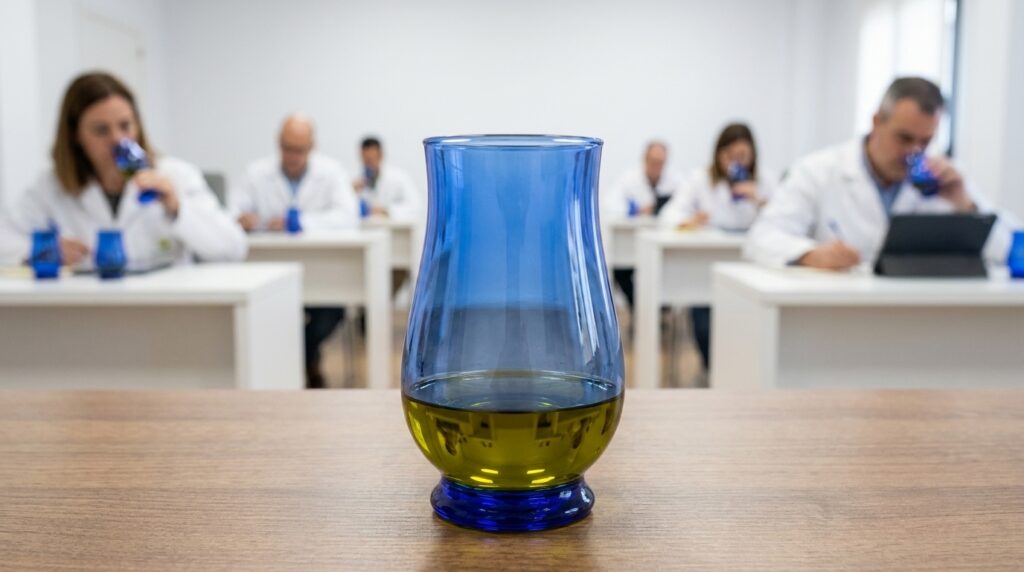
This is not a contest about personal preference. Olive oil tasting is a structured, repeatable discipline: tasters work from a blue glass — coloured so the oil’s appearance cannot bias the verdict — warming the sample in the hand, then assessing aroma and flavour against a defined vocabulary of positive attributes (such as fruity, bitter and pungent) and a catalogue of defects (such as rancid, fusty, musty or winey). The presence and intensity of those defects is precisely what separates an extra virgin oil from a lower grade.
Why a tasters’ competition matters
Behind the prizes lies a serious policy goal. Sensory analysis is a legal requirement, not a marketing flourish: an oil cannot be classified and labelled as extra virgin on chemistry alone. It must also pass the verdict of an accredited tasting panel. That makes the human palate an irreplaceable instrument of quality control — and a scarce one.
The region frames the competition as a way to give visibility to a profession the general public barely knows exists, to reinforce the taster’s role as a guarantor of quality, to attract new talent, and to encourage generational renewal in a discipline that demands constant, rigorous training. In other words, it is as much about building the next generation of tasters as it is about crowning the current best.
Inside the El Encín panel: 16 experts, 300 tastings a year
The choice of venue is no accident. El Encín is home to the Official Virgin Olive Oil Tasting Panel of the Community of Madrid, managed by IMIDRA. The panel is made up of 16 specialists who carry out more than 300 tastings a year, vouching for the quality of oils produced both in Madrid and in other regions.
The panel’s work is officially recognised by Spain’s Ministry of Agriculture and by the International Olive Council, and it is accredited by ENAC under the ISO 17025 standard for testing laboratories — the same benchmark applied to formal analytical labs. Producers send their samples to El Encín, where each oil undergoes both physical-chemical and sensory analysis before being classified. If an oil falls short of the standard required, it is directed to refining rather than sold as virgin. It is this process that allows a bottle to legitimately carry the extra virgin label.
The estate itself is one of Madrid’s quiet research treasures, also hosting the third-largest grapevine variety collection in the world.
The backdrop: a young but fast-growing olive oil region
Madrid is rarely the first name that comes to mind in Spanish olive oil, yet the region has been growing olives since Roman times and has spent the last few years building a distinct identity around quality. The European Commission recognised the PDO Aceite de Madrid in 2023, after a process that began in 2019.
The numbers tell the story of a small but rising producer. The region counts more than 20,000 hectares of olive groves spread across close to a hundred municipalities — concentrated in the comarcas of La Campiña, Las Vegas and the south-west — worked by several thousand growers. Average annual olive oil production sits between 4 and 6.5 million kilos.
The oils are built on local character. Under the PDO rules, the majority varieties — Cornicabra, Castellana and Manzanilla Cacereña — must make up at least 80% of the blend, complemented by native minority varieties such as Carrasqueña, Gordal, Asperilla and Redondilla. Certified Aceite de Madrid is required to show medium-to-high sensory intensity, at least three fruity notes, total polyphenols above 300 ppm at extraction, and acidity no higher than 0.8 degrees.
Demand for the seal is accelerating. Certified PDO output jumped 110% in its second campaign, rising from roughly 16,200 litres in 2023/24 to about 34,000 litres the following season, with thirteen brands across a dozen municipalities and thirteen mills now bottling under the designation — three of them exclusively organic. In 2025 the region collected an Excellence Award at the World Olive Oil Exhibition, a signal of growing international ambition.
The bigger picture
Spain is the world’s largest olive oil producer, and the credibility of its top grades rests on a chain of trained tasting panels working largely out of public view. By turning that work into a public competition — complete with serious prize money and an open door for amateurs — Madrid is doing something clever: protecting the technical rigour that underpins quality while inviting a wider audience to understand, and perhaps one day join, the craft of the olive oil taster.
For producers, sommeliers, importers and serious enthusiasts alike, October’s contest at El Encín is worth watching. It is a reminder that great oil is not only grown and milled — it is also judged, glass by glass, by people trained to taste what most of us would miss.
Entries for both categories are open for one month following publication of the official rules in the Boletín Oficial de la Comunidad de Madrid (BOCM). Full conditions, eligibility requirements and the application form are published with those rules.
Leave a Reply