Iran War Disrupts Premium Olive Oil Supply Chains Across the Eastern Mediterranean
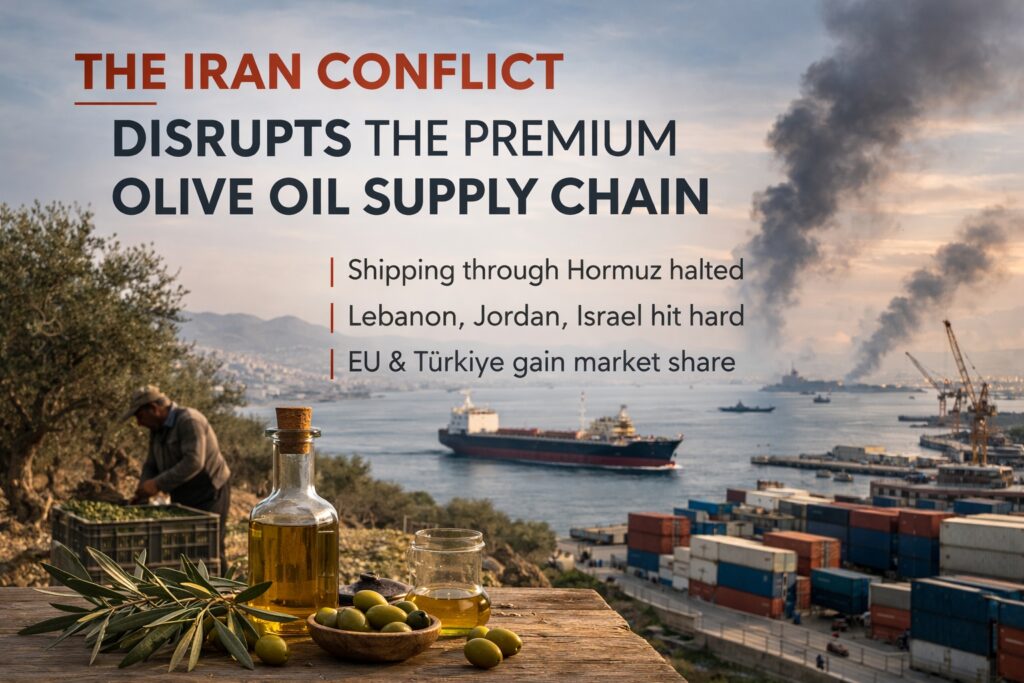
The escalation of conflict involving Iran has begun to ripple far beyond energy markets, creating new disruptions for the global premium extra virgin olive oil (EVOO) trade. While the olive sector is far removed from the geopolitical frontlines, producers across the Eastern Mediterranean are now facing a combination of logistical paralysis, rising costs and shrinking export opportunities.
At the center of the disruption is maritime traffic through the Strait of Hormuz, one of the world’s most critical shipping corridors. The conflict has sharply reduced commercial vessel traffic in the area, pushing up freight rates, war-risk insurance premiums and energy prices. For the premium olive oil sector — which depends on stable export logistics and carefully controlled storage conditions — the consequences are immediate.
The main shock to the olive oil sector is not coming from the groves themselves, but from the wider energy and logistics system. According to Reuters, shipping traffic through the Strait of Hormuz has dropped by as much as 97% since the conflict began, a critical disruption given that the passage normally carries roughly one-fifth of the world’s oil and liquefied natural gas trade. War-risk insurance premiums for vessels operating in the Gulf have surged fivefold, while Brent crude was trading near $100 per barrel on March 13, after briefly reaching $119.50 earlier in the week. European policymakers are already warning of a renewed inflationary shock tied to energy prices. For the premium olive oil industry, the consequences are indirect but significant: higher diesel costs for farm machinery and transport, rising freight and insurance bills, and increasing pressure on packaging — particularly glass bottles, whose production is highly energy-intensive. Food manufacturers and exporters are already warning that the surge in energy prices is feeding directly into logistics and packaging costs across the supply chain.
Unlike bulk commodities, high-end EVOO typically moves in small, high-value shipments destined for specialty retailers, restaurants and luxury food markets in Europe, North America and East Asia. Delays, rerouting and higher transport costs are already complicating export schedules and squeezing margins across the supply chain.
Uneven Impact Across Producing Countries
The effects of the crisis are not uniform across the region. Countries directly exposed to the conflict or its economic fallout are experiencing varying degrees of disruption.
Lebanon, long known for its artisanal olive oils, appears among the most vulnerable. The country exports tens of millions of dollars’ worth of olive oil annually, much of it to diaspora and specialty markets in the United States, Canada and the Gulf. With large-scale population displacement and insecurity affecting agricultural regions, producers face growing difficulties accessing groves, securing labor and maintaining milling operations.
Jordan enters the crisis with an additional challenge: a sharply reduced harvest. Recent official figures indicate production dropped by more than half compared with the previous season, leaving limited export capacity even before the regional escalation. Export markets in the Gulf — traditionally key buyers — are now facing their own economic and logistical uncertainties.
Israel’s olive oil sector, though known for boutique premium producers, is structurally different. The country imports far more olive oil than it exports, meaning the broader market impact may be felt more through supply stability and retail prices than through lost export revenues. Smaller estates producing award-winning oils, however, still face disruptions tied to labor availability, logistics and security concerns.
In Iran, olive oil production remains relatively modest by global standards. Although the country’s premium producers have invested in quality improvements in recent years, export volumes remain limited. The greater challenge now lies in financial transactions, currency volatility, energy costs and access to international logistics networks.

Turkey and the Western Mediterranean Gain Relative Advantage
One notable exception in the region is Turkey, whose olive oil sector has grown rapidly over the past decade. With significantly larger production volumes and established export channels, Turkish producers may be better positioned to redirect shipments toward markets that lose supply from smaller Levantine exporters.
Meanwhile, producers in Spain, Italy, Greece and Portugal could benefit indirectly. The European Union remains the world’s dominant olive oil producer, and recent harvests have restored some stability after earlier drought-driven shortages. While European producers also face higher shipping and energy costs, their scale and logistics infrastructure provide a buffer that smaller Eastern Mediterranean producers often lack.
A Sector Sensitive to Logistics
The olive oil industry’s exposure to geopolitical shocks highlights a broader reality: high-quality food products are deeply tied to global logistics systems. Premium olive oil requires careful handling from harvest to bottling to international distribution. Any disruption — whether from conflict, fuel costs or shipping constraints — can ripple quickly through the market.
For now, the immediate effect is uncertainty rather than collapse. Eastern Mediterranean olive oils are unlikely to disappear entirely from global markets, but supply is expected to become less predictable and more expensive in the months ahead.
For consumers and retailers in major markets such as London, New York and Tokyo, that may translate into higher prices, longer lead times and a narrower selection of niche regional oils — at least until the geopolitical situation stabilizes.
In a sector built on heritage, terroir and small-scale production, stability is as critical as rainfall or soil quality. As long as the conflict continues to disrupt trade routes and regional economies, the premium olive oil market will remain on edge.
Leave a Reply